
Asset Allocation 101

August 2026
Asset Allocation 101: The Foundation of a Resilient Plan
If you’ve worked with us at all, you’ve undoubtedly heard us talk about asset allocation — more than once! An investment portfolio’s asset allocation is critical as it determines how well your plan holds up while markets do what markets do, which is go up and go down.
As of August 6, 2026, U.S. equity markets were near record highs — which tend to bring out a very predictable, very human urge: “Things are going so well… maybe I should own more stocks.” Record highs in the markets tempt us to pile in, and downturns tempt us to bail out. Both feel reasonable emotional responses in the moment and likely cost us in hindsight. You may recall the dotcom bubble of 2000–2002, the Great Financial Crisis of 2008–09, and Covid in 2020.
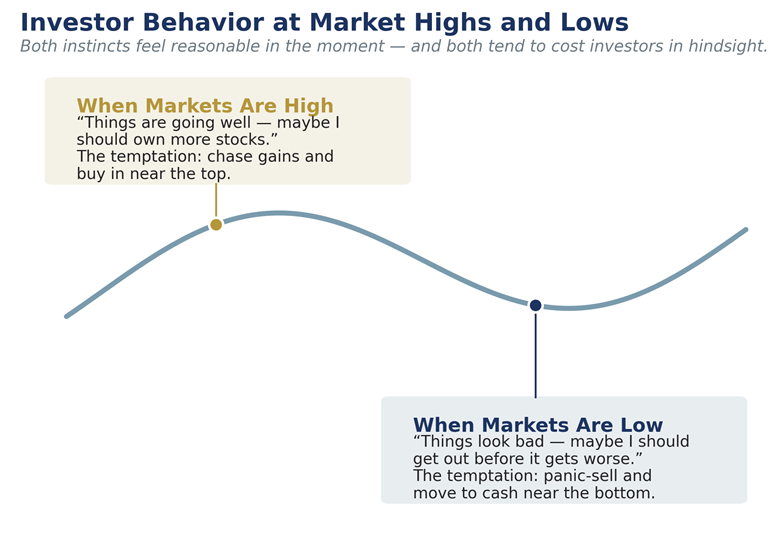
Illustration 1: Investor Behavior at Market Highs and Lows
Source: Morningstar, “Mind the Gap” study (2025), which tracks the gap between fund total returns and the returns investors actually capture based on the timing of their purchases and sales.
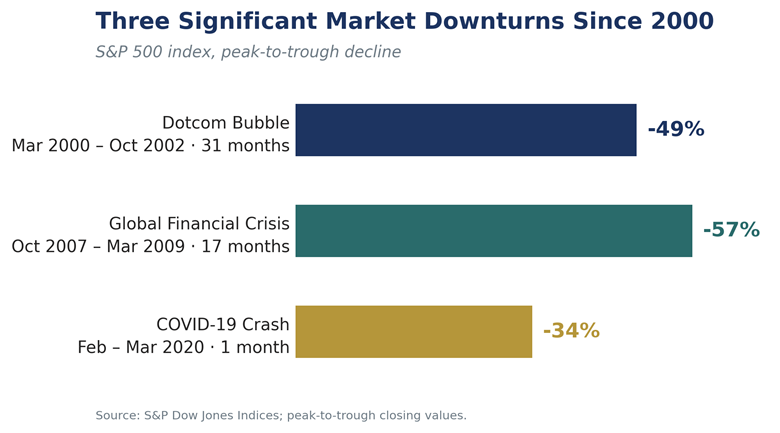
Illustration 2: Three Significant Market Downturns Since 2000
A quick refresher. Asset allocation is how your money is split between the different investment classes — stocks, bonds, cash, and sometimes alternative investments. Your personal asset mix should be based on your goals, timeline, and risk comfort. It’s not about picking winners and more about building a mix that weathers different market environments without derailing your plan.
Why It’s the Foundation, Not a Footnote
Academic research has found that asset allocation explains a significant portion of the variation in a portfolio’s returns over time. That finding has held for decades: most of a portfolio’s long-term behavior comes down to asset class allocation, not the specific investments held within it. Stock picking and market timing get the headlines; allocation does the heavy lifting — which is why we treat it as the foundation of a resilient plan rather than a one-time decision. A resilient plan does not avoid down markets; it’s built so a down market doesn’t force a bad decision at the wrong time.
How Allocation Shifts Across Life Stages
Your ideal mix isn’t static — it evolves with your circumstances, time horizon and risk tolerance. As a general rule there are three broad life stages:
Accumulators (early-to-mid career) have the longest time horizon and the highest capacity to ride out volatility. For this group a downturn today is, in many ways, an opportunity — buying at lower prices with years to recover. This group can typically handle a heavier stock allocation.
Pre-retirees (roughly 5–10 years until retirement) face different math: a significant drop in the markets now gives their portfolio less time to recover before withdrawals begin. At this stage we begin encouraging a dialing back of risk — shifting some stock exposure toward more stability.
Retirees need income now, while still outpacing inflation over a long retirement. The question shifts from “how much can I grow” to “how much do I need now to keep up with inflation and protect my assets in the event of a significant downturn”. Time horizon isn’t zero here — it’s just measured differently, often across the client’s life expectancy.
The thread across all three: the relationship between risk tolerance and time horizon. Time horizon is math — how long your money needs to work for you. Risk tolerance is personal — how much volatility can you stomach without losing sleep. A resilient allocation accounts for both.
What Is Portfolio Drift?
Once you set a target allocation, it doesn’t stay idle. Say you started with 60% stocks and 40% bonds. After a strong year for stocks, that mix might quietly become 68/32 — without you doing anything at all. That’s drift: a portfolio wandering from its target because different assets grow at different rates. Left unchecked, it can leave you carrying more risk than intended since strong bull markets are exactly when equity allocations tend to creep upward.
Common Mistakes to Avoid
- Setting it once and forgetting it. Without periodic check-ins, drift takes over, and your risk level quietly shifts underneath you. This is exactly what our quarterly meetings with Jenifer and Tammy are for — a review of your portfolio to evaluate whether your allocation still matches your plan.
- Reacting to headlines instead of your plan. Chasing what’s hot or fleeing what’s down usually means buying high and selling low.
- Treating accounts in isolation. Many folks miss this. Your 401(k), IRA, and taxable accounts should work together toward one overall allocation; not each be invested in isolation.
- Confusing “conservative” with “safe.” Being too conservative too early in life carries its own risk — falling behind inflation over a long retirement.
Asset allocation decisions should be evaluated in the context of your whole plan, not as a separate decision. A single fund or a single year’s performance means little on its own. What matters is whether your overall investment mix matches your goals, timeline, and comfort with risk.
Foundation only gets you so far without maintenance. In our companion video, we’ll get tactical — how to set your target allocation (DIY or with us), and the when and how of rebalancing.
*Gary P. Brinson, Brian D. Singer, and Gilbert L. Beebower, Determinants of Portfolio Performance II: An Update, The Financial Analysts Journal, 47, 3 (1991)
Disclosure: Copyright (C) 2026 Mosaic FI, LLC. All rights reserved.
Mosaic FI, LLC is a Registered Investment Adviser, registered with the SEC and in other states where required, unless otherwise exempt. Registration does not imply a certain level of skill or training. Information presented is for educational purposes only and does not intend to make an offer or solicitation for the sale or purchase of any specific securities, investments, or investment strategies. Investments involve risk and, unless otherwise stated, are not guaranteed. Be sure to consult with a qualified financial adviser and/or tax professional before implementing any strategy discussed herein. Past performance is not indicative of future performance.
The opinions expressed herein are those of Mosaic FI, LLC as of August 6, 2026, and are subject to change without notice. This material is provided for general informational and educational purposes only and should not be construed as personalized investment, legal, or tax advice.While Mosaic FI, LLC believes this information to be current and valuable to its clients, and does not contain untrue statements of material facts, or misleading information, Mosaic FI, LLC provides these links on a strictly informational basis only and cannot be held liable for the accuracy, time-sensitive nature, or viability of any information shown on these sites.

share this post
share on facebook
email to a friend
pin to pinterest